

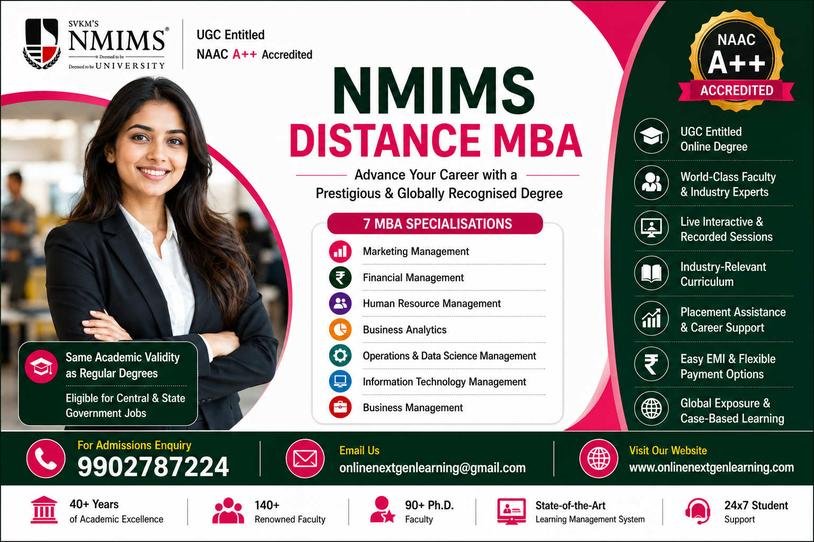
UGC Recognized Online MBA Srinagar
For many professionals, returning to education becomes practical only when the learning model can fit around an existing routine. In Srinagar, the UGC Recognized Online MBA Srinagar offers a way to approach management education through an online academic structure. The attraction is not simply convenience; it is the possibility of developing a broader understanding of business while continuing with work and other responsibilities.
Management Education in Srinagar
Recent graduates may find the broader management perspective useful when they are still deciding which business function to pursue. Exposure to finance, marketing, human resources, operations, analytics and information technology can help learners compare different professional interests. Rather than choosing a career path based only on a job title, a student can consider the type of work, skills and decision-making responsibilities associated with each function.
The Role of NMIMS CDOE
Recognition is another factor that should be reviewed carefully. The supplied source states that NMIMS is recognised by the University Grants Commission for awarding degrees under the applicable framework and reports NAAC A++ accreditation with a 3.67 CGPA out of 4.00. Academic validity, employment acceptance and eligibility for further study can still depend on the rules of the relevant employer, institution or regulatory body.
What Learners Can Expect From the MBA
One useful feature of management education is its breadth. Business decisions rarely remain inside one department. A marketing decision can influence finance; staffing can affect operations; technology can change customer service; and financial planning can determine how quickly an organisation expands. Studying several management functions helps learners in Srinagar see these relationships and develop a more connected view of organisational performance.
Balancing Employment and Higher Education
Working professionals may approach the same programme with a more specific objective. They may already understand a particular industry but want to move beyond a narrow functional role. Management education can introduce frameworks for strategy, finance, leadership and business analysis that complement experience gained at work. In a city such as Srinagar, where a major regional centre where tourism, handicrafts, services, trade, education and entrepreneurship create varied business requirements, this broader perspective can be relevant to professionals seeking increased responsibility.
Curriculum and Semester Progression
Learning through an online platform does not remove the need for academic discipline. A sensible routine can divide the week between lectures, reading, assignments, revision and assessment preparation. Learners in Srinagar can choose a study location that suits their circumstances, whether that is at home, in a quiet office space or another suitable place with reliable connectivity. Consistency is usually more useful than attempting large amounts of study immediately before assessments.
Eligibility and Admission Planning
Professionals also need to consider how they intend to use the qualification. Someone working in sales may be interested in customer behaviour and brand strategy, while an operations employee may want stronger process and analytical knowledge. An entrepreneur may value finance, people management and business planning. The relevance of an UGC Recognized Online MBA Srinagar therefore depends on the learner’s career direction and on the way the acquired knowledge is applied at work.
Choosing a Specialisation
Srinagar offers a useful setting in which to think about management education because it has a major regional centre where tourism, handicrafts, services, trade, education and entrepreneurship create varied business requirements. A learner does not need to treat local conditions as a limitation; instead, familiar organisations can become practical reference points for understanding customer service, operations, workforce planning, finance and growth. The wider purpose of an MBA is to develop concepts that can be adapted to different organisations rather than memorised for a single workplace.
An UGC Recognized Online MBA Srinagar can therefore be approached as a structured academic opportunity rather than simply a convenient online qualification. The learner can connect coursework with professional situations, compare different management functions and gradually build a broader business vocabulary. For someone already working in Srinagar, this can support a more deliberate approach to career planning while maintaining continuity with existing responsibilities.
Career Applications
- Marketing Management — Marketing Management can be useful for understanding customer needs, positioning, communication, market research and the commercial decisions behind attracting and retaining customers.
- Financial Management — Financial Management focuses attention on financial planning, interpretation of business information, resource allocation and decisions that influence organisational stability and growth.
- Human Resource Management — Human Resource Management examines people-related responsibilities such as recruitment, development, performance, employee relations and the alignment between workforce capability and organisational goals.
- Operations & Data Science Management — Operations & Data Science Management connects operational thinking with data-oriented decision-making, helping learners consider processes, efficiency, information and measurable performance.
- Business Management — Business Management provides a broad perspective across functions and can be relevant to learners who expect to coordinate people, resources and business priorities rather than remain within one narrow department.
- Business Analytics — Business Analytics develops an orientation towards using data to understand patterns, support decisions and evaluate business performance rather than relying entirely on intuition.
- Information Technology — Information Technology is relevant to the management of technology-enabled work, digital systems and the way technology supports organisational processes and business objectives.

Fee Structure
The supplied source lists the Online MBA as a two-year programme and gives the following fee figures: ₹1,05,000 as the annual fee, ₹55,000 as the semester fee, and ₹1,96,000 as the full programme fee. These figures are reproduced from the supplied material for reference. Prospective students should confirm the current official fee schedule, payment conditions and any applicable charges before making an admission decision.
Fee planning should be considered alongside the learner’s wider study budget. A student in Srinagar may also need to account for internet access, a suitable device, study time and other personal commitments. Looking at the complete cost of participation can make the decision clearer than focusing on a single fee figure. The fee should always be checked against the latest official information before enrolment.
Benefits of an Online MBA
- The programme covers several management functions rather than concentrating on one business department.
- Digital resources can support independent revision and organised study.
- Multiple specialisation options allow learners to align later study with professional interests.
- Academic support and faculty interaction can help students work through coursework and assessments.
- Management learning can strengthen business understanding, analytical thinking and structured decision-making.
- A recognised postgraduate qualification can form part of a learner’s longer-term professional development plan, subject to applicable employer and regulatory requirements.
- A flexible online format can allow study to continue alongside professional responsibilities.
The Learning Experience
The quality of the learning experience also depends on student support. The source material describes digital study resources, faculty interaction, assessments and academic assistance as parts of the learning environment. These features matter because online study requires learners to resolve questions, track coursework and understand assessment expectations without relying on daily physical classroom contact.
The local economy can also provide useful context for management learning. Because Srinagar has a major regional centre where tourism, handicrafts, services, trade, education and entrepreneurship create varied business requirements, a learner can relate classroom concepts to familiar organisations and professional situations. Marketing ideas may be considered through local businesses, operations concepts through service or industrial activity, and financial principles through the way organisations plan resources. This practical connection can make abstract management topics easier to understand.
Practical Considerations Before Enrolment
Digital education changes the learner’s role. Recorded learning resources, online study material, assessments and faculty interaction can support a more self-directed approach. The learner must decide when to study, how to revise and how to keep pace with academic requirements. This can be useful for working professionals in Srinagar, because the same discipline required to manage an online course can also strengthen habits of planning and prioritisation.
A prospective student should also look beyond promotional language and examine practical details before admission. Curriculum coverage, eligibility, fee commitments, examination arrangements, study resources, support services and the current recognition status are all worth checking. This approach helps a learner in Srinagar make a decision based on personal circumstances rather than choosing a programme only because online study appears convenient.
Admissions and Contact Details
Learners in Srinagar who want admission assistance or further information about the management programmes can contact the admission support team using the details below. Before applying, applicants should review the current programme information, eligibility requirements, fee schedule and applicable academic conditions.
Email: onlinenextgenlearning@gmail.com
Phone: +91 9902787224
Conclusion
The UGC Recognized Online MBA Srinagar can be relevant to different learners in Srinagar, from recent graduates to experienced professionals and entrepreneurs. Its online structure may make it possible to continue existing responsibilities while developing broader management knowledge. A careful review of eligibility, specialisation, fees, academic support and recognition should remain part of the final decision. With a disciplined study routine, the programme can become one component of a longer professional development journey.
Communication is another management capability that develops through academic work. Preparing assignments, interpreting case situations and explaining a recommendation require a learner to organise information clearly. These habits have practical value in professional settings, where managers may need to present an idea to colleagues, justify a budget, explain a process or communicate a change to a team.
Technology also changes the way organisations operate. Managers increasingly encounter dashboards, digital workflows, online customer channels and technology-supported decisions. An MBA learner does not need to become a specialist in every technology, but understanding how digital tools affect business processes can improve conversations with technical teams and help managers make more informed organisational choices.