
Looking for an Online MBA in Bhubaneswar
Looking for an Online MBA in Bhubaneswar is relevant for professionals who want career development without unnecessary interruption. NMIMS CDOE offers a digital route where learners can engage with academic content, live learning, assessments and online support. This can suit students, employees and businesspeople who need education to fit around an established routine.
NMIMS CDOE provides a career-oriented online learning route for people at different stages. Graduates can use it to build management fundamentals, while working professionals can add academic depth to their existing experience. Entrepreneurs and businesspeople can also use the curriculum to develop a more systematic approach to planning, financial decisions, customers, people and organisational growth.
Why an Online MBA can support professional growth
With professional activity spanning IT services, infrastructure, education, government services, finance and startups, cross-functional capability can become increasingly important. Managers are expected to understand how different parts of an organisation influence one another. Formal management education can introduce frameworks that help learners connect finance, marketing, operations, people and strategy.
Professional growth often depends on the ability to communicate across functions. Managers may work with finance teams, operations specialists, marketers, technology professionals and senior leaders. Management education introduces a common business vocabulary and can improve the ability to interpret different priorities.
An online management qualification can be especially useful when professional responsibilities continue during study. Instead of separating education from work, learners can use their existing experience as a practical context for academic concepts. A project at work may raise questions about operations, a customer issue may connect with marketing, and a team challenge may relate to organisational behaviour. This connection can make learning more meaningful and can help students recognise how different management disciplines work together.
Management is also about decision quality. Leaders rarely have perfect information, unlimited resources or unlimited time. They have to evaluate alternatives, understand risk, communicate priorities and make choices that affect people and business performance. Structured management education can introduce frameworks for these decisions. Learners can then adapt those frameworks to their own professional environment, supported by experience and practical judgement.
Legacy of NMIMS CDOE and its academic foundation
NMIMS CDOE forms part of a university with a long management-education history. Since its roots in 1981, the institution has expanded its academic portfolio and developed strong links with professional and industry environments. This legacy provides context for learners who want an online qualification connected to an established university identity.
The legacy is relevant because learners are choosing an academic institution as well as a delivery format. A long-standing university environment can provide broader academic context, faculty expertise, institutional processes and exposure to professional expectations. NMIMS CDOE extends that environment through digital learning, making it possible for learners to pursue management education without relocating for daily classroom attendance.
For working professionals, this combination can provide continuity. They can retain the benefit of current employment while developing new academic knowledge. For graduates, it can provide a structured management foundation. For entrepreneurs, it can offer frameworks that can be related to customers, costs, people, operations and growth. These different use cases make online management education relevant to a wide range of learners.
Accreditation and High Value
NMIMS CDOE is associated with an institution that currently highlights NAAC A++ accreditation with a 3.67 CGPA in the 2025 fourth cycle and Category-I autonomy under the UGC graded-autonomy framework. Official NMIMS information also describes its online programs as UGC-entitled and recognised through the applicable UGC-DEB framework. These credentials are important when learners evaluate the academic standing and regulatory context of an online degree.
The academic validity of recognised online degrees can make them relevant for corporate employment, higher studies and professional progression, subject to the applicable rules of the employer or institution. For Central or State Government recruitment, eligibility depends on the specific recruitment notification and prevailing rules. Therefore, learners should verify the requirements for a particular position instead of assuming that every government role follows identical criteria.
Accreditation also provides a useful quality signal. NAAC evaluates institutional quality across defined parameters, while UGC recognition and the applicable DEB framework provide regulatory context for online and distance education. Category-I autonomy reflects the university’s status under the relevant graded-autonomy regulations. Together, these points give learners a stronger basis for evaluating an institution beyond the convenience of online delivery.
Management in short: what learners can gain
Career growth often introduces decisions with incomplete information. Professionals may have to prioritise projects, evaluate alternatives, manage stakeholders and accept trade-offs. Management education can provide frameworks for examining these situations. It can also strengthen professional communication by encouraging learners to interpret evidence and explain recommendations clearly.
Students can also develop professional communication through management study. Managers must explain decisions to people with different priorities, interpret information, prepare recommendations and respond to questions. These capabilities can support career development because business decisions are rarely successful when they are not communicated effectively.
Time management and independent learning are additional parts of online education. Learners need to organise reading, attend sessions, prepare assignments and meet assessment deadlines while managing other responsibilities. This can encourage disciplined study habits. For professionals, the ability to maintain a learning routine while working can itself become a useful professional capability.
Why students choose NMIMS CDOE
Students may choose NMIMS CDOE for its university ecosystem, online learning format, academic support and career-oriented approach. The program can help graduates establish fundamentals and help employees connect academic theory with practical experience. The qualification should be viewed as part of a wider career plan rather than as an automatic guarantee of a job or promotion.
The choice can also be evaluated from the learner’s stage of career. A graduate may value foundational business knowledge and exposure to management concepts. An experienced employee may value the opportunity to formalise workplace knowledge and prepare for a leadership role. A business professional may value structured approaches to strategy and growth. NMIMS CDOE can accommodate these different objectives through an online academic format.
Learners should nevertheless make an informed decision. They should check the current program structure, admission eligibility, fees, examination requirements and recognition information before enrolment. The most suitable qualification is the one that fits the learner’s career objectives, professional experience, available study time and intended future role.
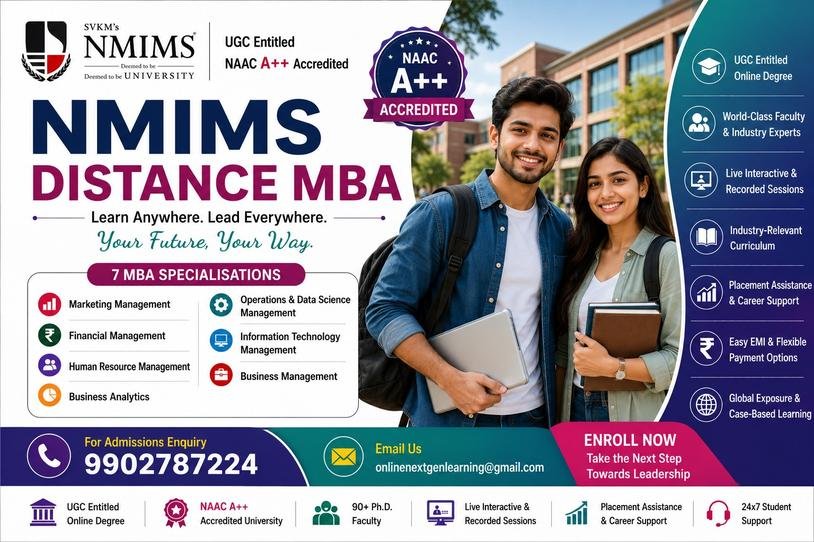
Seven Online MBA specialisations
The Online MBA offers the following specialisation options:
- Marketing Management
- Financial Management
- Human Resource Management
- Operations & Data Science Management
- Business Management
- Business Analytics
- Information Technology
How online classes and academic learning work
A flexible online learning model can combine scheduled academic interaction with independent study. Learners can use digital resources to prepare for subjects, attend live sessions when scheduled, revisit recorded content and complete assessments according to the academic calendar. This approach can be useful for professionals because study does not have to be limited to a daily campus timetable.
- Live interactive sessions – Faculty-led academic interaction can support discussion, clarification and participation.
- Recorded lectures – Recorded learning can be revisited when learners need additional revision or a different study pace.
- Digital academic resources – Online materials can support preparation and independent learning outside scheduled sessions.
- Continuous assessments – Regular academic activity encourages consistent engagement instead of leaving all preparation until examinations.
- Student support – Academic and technical assistance can help learners navigate the online learning environment.
The effectiveness of online learning depends partly on learner discipline. Students should create a realistic study schedule, protect time for reading and assessments, and remain active during academic sessions. Working professionals can divide study into manageable periods rather than waiting for large blocks of free time. This can make the learning routine more sustainable over the duration of the program.
Career growth after completing the Online MBA
One advantage for working learners is the ability to test academic concepts against workplace situations. A learner can study operations and observe process issues, learn financial principles and review project costs, or study marketing and analyse customer behaviour. This connection can make education more practical and help convert theory into professional capability.
A qualification does not automatically create a particular salary, job title or promotion. Career outcomes depend on previous experience, skills, academic performance, industry conditions and employer requirements. The MBA can strengthen the academic side of a professional profile, while practical achievements and communication skills remain important. Learners should therefore treat the degree as one component of a wider career-development strategy.
The management concepts can be applied across many professional situations. A sales employee can use customer and market concepts; an operations professional can apply process and resource frameworks; an HR professional can use organisational behaviour and people-management ideas; a technical specialist can use strategy and leadership knowledge when moving towards project responsibility. This transferability is one reason management education can remain useful even when a learner changes roles.
For entrepreneurs and businesspeople, the learning can be used to examine growth plans, customer segments, pricing, costs, organisational structure and operational efficiency. The value comes from applying academic frameworks thoughtfully rather than simply memorising concepts. This practical orientation can help learners develop a more systematic approach to business decisions.
Alumni, professional exposure and long-term value
An established university ecosystem can provide professional exposure beyond the classroom. Alumni networks may help learners understand different industries, career paths and workplace experiences. Networking does not guarantee a job or promotion, but it can broaden professional awareness and create opportunities for peer learning. Career services and employer relationships can similarly provide support, although individual outcomes depend on each learner’s profile and performance.
For students, the alumni environment can provide a view of possible career directions. For working professionals, it can offer insight into how people in different industries have developed their careers. For businesspeople, interaction with other professionals can create new perspectives on management challenges. NMIMS CDOE can therefore be considered not only for the qualification but also for the broader academic and professional ecosystem connected with the university.
Long-term value also comes from continuous learning. Management practices change as technology, customer expectations, data use and organisational structures evolve. An MBA can provide foundational frameworks, but professionals should continue updating their skills after graduation. The strongest career strategy combines formal education with practical experience, communication, digital capability and a willingness to keep learning.
Students: why choose NMIMS CDOE only?
In short, learners may choose NMIMS CDOE for its combination of university legacy, NAAC A++ accreditation, 3.67 CGPA, Category-I autonomy, applicable UGC-DEB recognition, flexible digital learning and career-oriented management education. It can suit students who want a structured foundation, working professionals who want career continuity and businesspeople who want formal management frameworks. Applicants should still verify the latest official program details before enrolment.
Conclusion
An online MBA can be a useful platform for developing broader business judgement while continuing professional activity. Its value is strongest when learners connect academic concepts with real workplace situations, build communication and analytical skills, and use the qualification as part of a longer career plan. NMIMS CDOE provides a university-backed online learning route for people who want management education with flexibility.
The final choice should be based on verified information, personal career objectives and the learner’s ability to commit consistent time to study. Applicants should review the latest eligibility requirements, curriculum, fees, assessment rules and recognition information before making an admission decision. A thoughtful choice can help ensure that the qualification supports both immediate learning needs and longer-term professional ambitions.
Admissions and details
For admissions and details regarding Online MBA, Online BBA, Online B.Com or Online WXMBA programs, prospective learners can use the contact details below. Applicants should verify the latest official admission schedule, eligibility criteria, fee structure and program conditions before payment.