

Looking for an Online MBA in Agra
For many professionals, the decision to pursue management education begins with a question of timing rather than ambition. Looking for an Online MBA in Agra can mean finding a program that supports career continuity while building formal business knowledge. NMIMS CDOE is relevant to this need because its online delivery is designed for learners who cannot follow a conventional daily campus schedule.
NMIMS CDOE can also appeal to students who want a recognised university environment without relocating for every academic activity. The online format allows the learner to access coursework and participate in academic processes through digital platforms. For working employees, this means the education plan can be organised around professional commitments rather than forcing a complete break from employment.
Why an Online MBA can support modern careers
The employment environment is shaped by tourism, footwear, handicrafts, manufacturing, retail and services. This creates opportunities for learners who can combine functional expertise with managerial capability. As careers progress, responsibilities often expand from execution to planning, coordination and decision-making. An online management program can provide the academic framework needed to understand those wider responsibilities while allowing the learner to keep building practical experience.
Leadership is not limited to senior executives. Team leaders, project coordinators and functional specialists may all need managerial thinking as their responsibilities grow. Formal study can help learners understand decision-making models, stakeholder expectations, business analysis and organisational behaviour, giving them concepts that can be applied well beyond the classroom.
Legacy and academic foundation
An established academic foundation for digital learners. NMIMS CDOE is the dedicated distance and online learning centre of SVKM’s Narsee Monjee Institute of Management Studies. Its online and open-distance learning journey began in 2013 with a state-of-the-art Learning Management System intended to provide interactive learning through connected digital platforms accessible 24/7. The wider university traces its institutional history to 1981 and has more than four decades of academic development.
Accreditation and high value
Academic recognition matters when a learner is choosing a management qualification. The current institutional information from NMIMS states that the university has a NAAC A++ accreditation with a 3.67 CGPA and holds Category-I autonomy under the UGC graded-autonomy framework. These credentials support the standing of the university’s degrees. As with any qualification, acceptance for a particular government position or corporate role remains subject to the relevant employer, regulator or recruitment rules.
- NAAC A++ with a 3.67 / 4.0 CGPA.
- UGC Category-I autonomy under the applicable graded-autonomy framework.
- UGC-aligned online education with statutory approvals for online learning.
- Academic and professional utility for employment, further study and career progression, subject to applicable requirements.
- University-backed credentials issued through the university’s own academic delivery framework.
Management learning in short
The management curriculum is designed to build a broad business perspective. Learners work with areas such as accounting, economics, organisational behaviour, marketing, human resources, strategy, operations, analytics and research. The value of this coverage is that it helps learners understand how different parts of an organisation influence one another. A manager must often balance customer needs, financial limits, operational constraints, employee expectations and strategic priorities at the same time.
- Business thinking connecting decisions to organisational goals.
- Leadership awareness understanding teams, communication and responsibility.
- Analytical capability using data and structured reasoning to assess choices.
- Strategic perspective looking beyond immediate tasks towards longer-term outcomes.
- Professional communication presenting ideas clearly to colleagues, clients and stakeholders.
Why students choose NMIMS CDOE
Working professionals can consider NMIMS CDOE when career continuity is a priority. Live sessions, recorded lectures, digital resources and structured assessments make it possible to organise study around a professional routine. The program is also relevant for learners who want to add a management dimension to an existing technical or functional career.
NMIMS CDOE can be especially relevant when a learner needs academic structure without a conventional campus timetable. The program’s digital delivery supports working professionals, recent graduates and business learners who want to develop management capability while maintaining professional continuity. The choice should be based on the learner’s career objectives, eligibility, budget and preferred learning style.
How the online learning experience works
Online classes are organised to support continuity rather than a daily campus routine. Learners can attend scheduled academic interactions, revisit recorded material and use digital resources when preparing for assessments or revision.
- Live interactive sessions for direct academic interaction and questions.
- Recorded learning for revision and flexible study.
- Digital study resources to support preparation and coursework.
- Continuous assessments to encourage regular academic engagement.
- Online student support for academic and technical assistance.
Online MBA specialisations
The available specialisation options include:
- Marketing Management
- Financial Management
- Human Resource Management
- Operations & Data Science Management
- Business Management
- Business Analytics
- Information Technology
Career growth after completing the degree
Career progression can take different forms. Some graduates use the qualification to prepare for internal promotion, while others move into cross-functional responsibilities or explore a new business function. Entrepreneurs may use the learning to strengthen planning, financial discipline and organisational systems.
The learning can also strengthen readiness for responsibilities involving planning, reporting, stakeholder communication, project ownership and team coordination. For students, the qualification can provide a foundation for entering management-oriented functions. For working professionals, it can help formalise knowledge acquired through experience. For businesspeople, it can add structure to decisions around growth, finance, marketing and organisation design.
Alumni and professional exposure
Professional networks are valuable because career opportunities often develop through knowledge exchange, industry conversations and long-term relationships.
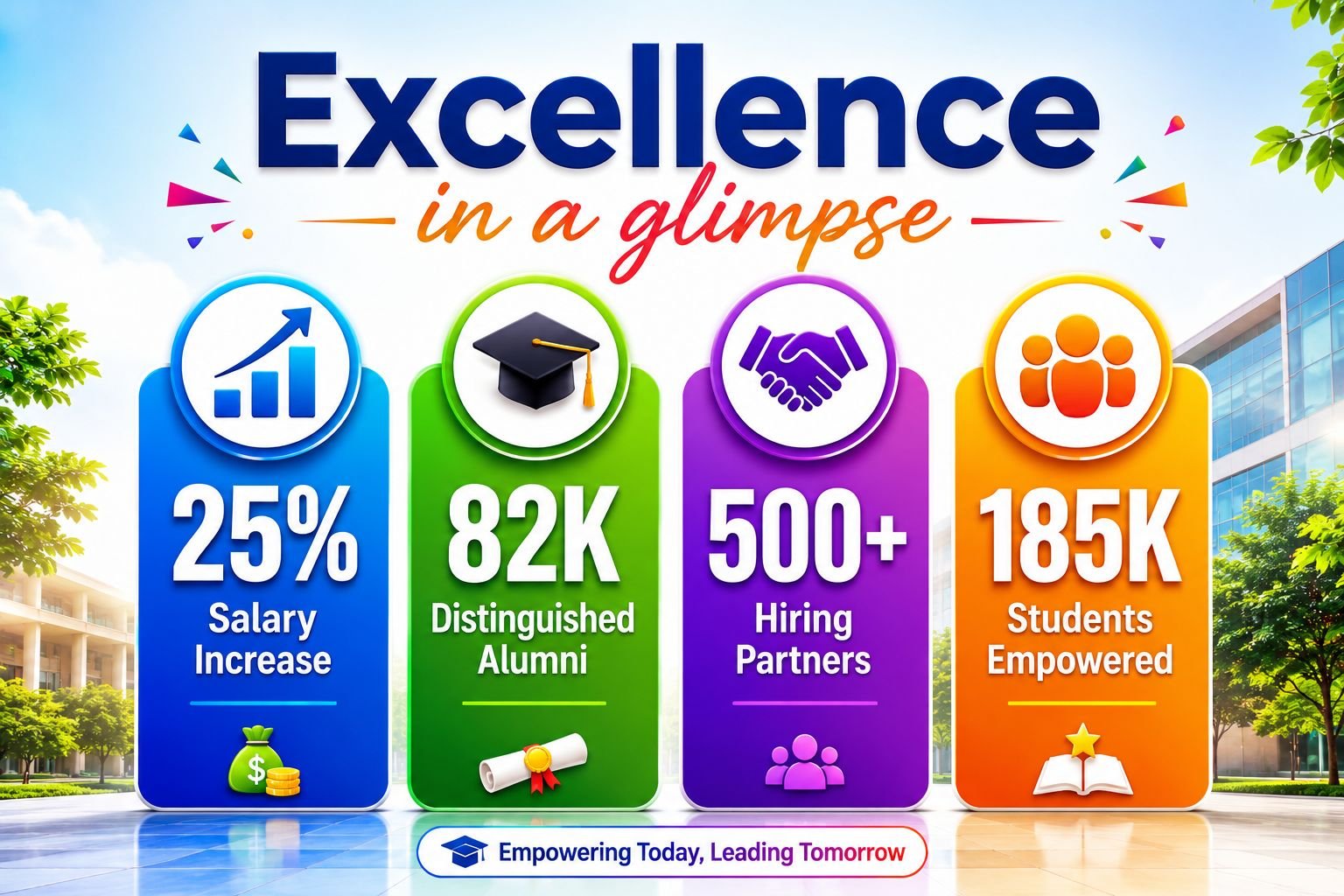
25% Salary Increased, 82K distinguished alumni, and 500+ Hiring Partners are marketing figures associated with the NMIMS online-learning ecosystem. These figures should be treated as ecosystem indicators rather than a guarantee of salary growth, placement or employment for every student.
In a professional environment shaped by the sectors discussed above, this broader management toolkit can be useful well beyond one job title. Consider how these skills translate into day-to-day responsibilities. A professional may need to prepare a business proposal, read a performance report, negotiate with a vendor, manage a small team or recommend a process improvement. Management study gives learners a vocabulary and a set of frameworks for approaching such situations more systematically.
It can also improve the connection between functional knowledge and organisational objectives. For a recent graduate, this creates a foundation for understanding how departments work together. For an experienced employee, it can make existing workplace experience easier to analyse and articulate in a managerial context. For a business owner, it can support more structured thinking about growth, costs, customer needs and people. The practical value comes from applying concepts repeatedly rather than treating the MBA only as an academic milestone.
Continuous learning also matters after graduation. Management practices evolve with technology, changing customer expectations and new forms of work. A learner who develops the habit of structured study can remain better prepared for future responsibilities and can keep connecting professional experience with new business ideas.
Admissions and further details
Students who need admission guidance or updated program information for Online MBA, Online BBA, Online B.Com or MBA (WX) programs can reach the support team through the details below.
Email: onlinenextgenlearning@gmail.com
Phone: +91 9902787224
A strong online management decision should consider recognition, learning support, curriculum fit and career objectives together. NMIMS CDOE brings these elements into a university-backed digital learning environment.