
Distance MBA from NMIMS Coimbatore
For professionals searching for a flexible management qualification, Distance MBA from NMIMS offers an online learning route that can fit around employment and other responsibilities. Students in Coimbatore may find this format particularly useful because learning can be accessed without the daily commute associated with a conventional classroom programme. The academic design combines core management concepts with specialised areas of business.
Coimbatore’s manufacturing, engineering, services and entrepreneurial ecosystem creates strong relevance for professionals developing management capabilities. The online format can help professionals continue working while pursuing postgraduate management education.
Learning without putting work on hold
Many professionals hesitate to pursue an MBA because they believe higher education requires a career break. An online format changes that equation. Students can plan weekly study hours, attend scheduled interactions when possible and use recorded learning resources for revision. Continuing employment while studying can also allow learners to relate management concepts to real workplace situations, making classroom theory more meaningful.
About NMIMS CDOE
NMIMS Centre for Distance and Online Education (CDOE) is the university’s dedicated academic unit for distance and online education. Its digital-learning model is designed for learners who need flexibility while pursuing higher education. It combines structured academic content, digital resources, faculty interaction and student support.
Historical Milestones
1981: The parent institution, SVKM’s NMIMS, was founded in Mumbai by Shri Vile Parle Kelavani Mandal (SVKM).
1994: The distance education arm, now known as the Centre for Distance and Online Education (CDOE), was established to serve learners and working professionals seeking flexible education.
2003: NMIMS was granted deemed-to-be-university status by the UGC.
2013: An advanced Learning Management System (LMS) was introduced to support the transition toward digital and online learning.
2018: NMIMS received Category-I autonomy status under the UGC framework and had achieved a NAAC A+ grade at that stage of its accreditation journey.
2024: NMIMS continued its online education expansion with UGC-DEB-recognised online management and degree programmes, strengthening its digital education ecosystem.
Accreditation & Recognition Facts
- NAAC Rating: A++ Grade with a CGPA of 3.67 / 4.0.
- UGC Status: Recognised and entitled under the applicable University Grants Commission (UGC) and Distance Education Bureau (DEB) framework for eligible online programmes.
- University Status: Category-I Deemed-to-be University under the applicable UGC framework.
NMIMS CDOE MBA Programme Highlights
The MBA is a two-year postgraduate management programme organised across four semesters. It covers foundational business disciplines and specialised management areas. Digital resources allow students to access learning remotely, while the academic schedule provides structure for classes, assessments and examinations. The format is suitable for learners with professional or personal commitments.
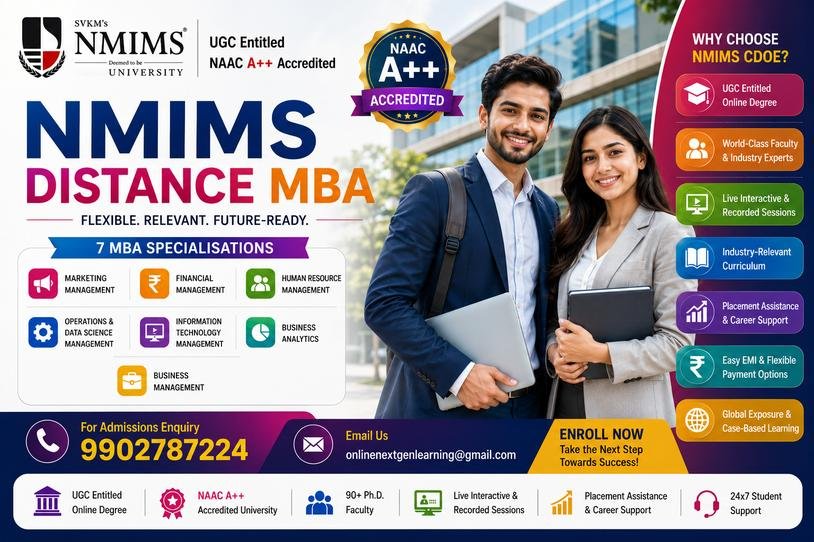
Seven MBA Specialisations
- Marketing Management: Focuses on brand building, consumer understanding, sales, digital marketing and integrated marketing communication. It suits learners whose professional interests match this business function.
- Financial Management: Focuses on financial analysis, corporate finance, investment decisions, valuation and financial strategy. It suits learners whose professional interests match this business function.
- Human Resource Management: Focuses on talent management, recruitment, employee development, compensation and organisational effectiveness. It suits learners whose professional interests match this business function.
- Operations & Data Science Management: Focuses on operations strategy, supply chain thinking, data-driven decision-making and business process improvement. It suits learners whose professional interests match this business function.
- Business Management: Focuses on general management, leadership, strategy, business communication and cross-functional decision-making. It suits learners whose professional interests match this business function.
- Business Analytics: Focuses on business intelligence, analytical thinking, data interpretation, visualisation and evidence-based management. It suits learners whose professional interests match this business function.
- Information Technology Management: Focuses on technology strategy, IT-enabled business transformation, digital systems and technology management. It suits learners whose professional interests match this business function.
Eligibility Criteria
Eligibility for the MBA (Online)
The current programme information states that applicants should hold a Bachelor’s Degree (10+2+3) in any discipline from a recognised university, or an equivalent degree recognised by the Association of Indian Universities (AIU), with a minimum of 50% marks at graduation level. The stated threshold is 45% for SC/ST/OBC/PwD categories. Admission requirements and applicable rules should be followed as specified for the relevant admission cycle.
NMIMS CDOE MBA Fee Structure
- Programme duration: 2 years / 4 semesters.
- Annual fee: ₹1,05,000.
- Semester-wise fee: ₹55,000 per semester.
- Full programme fee option: ₹1,96,000.
- Admission processing fee: ₹1,200.
- Examination fee: ₹800 per subject per attempt.
- Project fee: as applicable under the current university fee schedule.
- Financing/EMI facilities may be available through applicable financing partners and terms. Students should check the current payment options at the time of admission.
Admission Process
The admission process generally includes registration, completion of the online application, submission or verification of documents, payment of applicable fees and confirmation of admission. Students should keep academic records and identity details ready. After admission, learners receive instructions for accessing the digital learning environment and beginning the programme.
Benefits of Choosing NMIMS CDOE
A major advantage is the ability to study without relocating or following a daily campus timetable. Learners can plan study hours around work, use recorded resources for revision and participate in scheduled academic interactions. Multiple specialisations provide choice, while institutional recognition is an important factor when comparing online management programmes.
Key Programme Benefits
UGC-DEB recognised – Fully recognised online degrees
NAAC A++ Accredited – CGPA of 3.67 / 4.0 – Excellent rating
Recognised – In India and abroad
Accepted – For Employment, Higher Studies & Promotions
Same Academic Validity – As Regular Degrees
100% Financing Available – With 0% EMI Options
Eligible – For Central & State Government Jobs
No Age Limit – Learn at any stage of your career
No Career Break Required – Study while working full-time
Recorded Lectures – Learn at your own pace
Live Interactive Sessions – Direct faculty access
Continuous Internal Assessments – Reduced exam pressure
Dedicated Student Support – Academic & technical assistance
Online Exams with Flexible Slots – Convenience assured
Curriculum and Learning Approach
The curriculum introduces learners to communication, accounting, economics, organisational behaviour, marketing, quantitative methods, human resources, strategy, analytics, legal aspects of business and operations. Specialised subjects then provide deeper exposure to the selected management function. This progression builds broader business understanding alongside functional knowledge.
Career Opportunities After the MBA
An MBA does not automatically guarantee a particular job or salary, but it can add formal management education to a candidate’s professional profile. The strongest results usually come when learners combine the qualification with practical experience, communication skills, analytical ability and a clear career objective.
Potential career areas include marketing, finance, HR, operations, business analytics, project management, business development, general management and technology management. Actual outcomes depend on experience, skills, employer requirements, role availability and individual performance.
Who Should Consider This Programme?
The programme can suit recent graduates, working professionals, entrepreneurs and employees preparing for greater responsibilities. It may also help professionals considering a functional transition where a particular specialisation supports their intended career direction.
Conclusion
Distance MBA from NMIMS Coimbatore can be considered by learners seeking a flexible postgraduate management qualification backed by an established university. Its combination of online learning, seven specialisations, structured academic progression, institutional recognition and flexible study arrangements makes it relevant to graduates and professionals. Prospective learners should compare their career objective, preferred specialisation, eligibility, fees and current admission requirements before enrolling.