

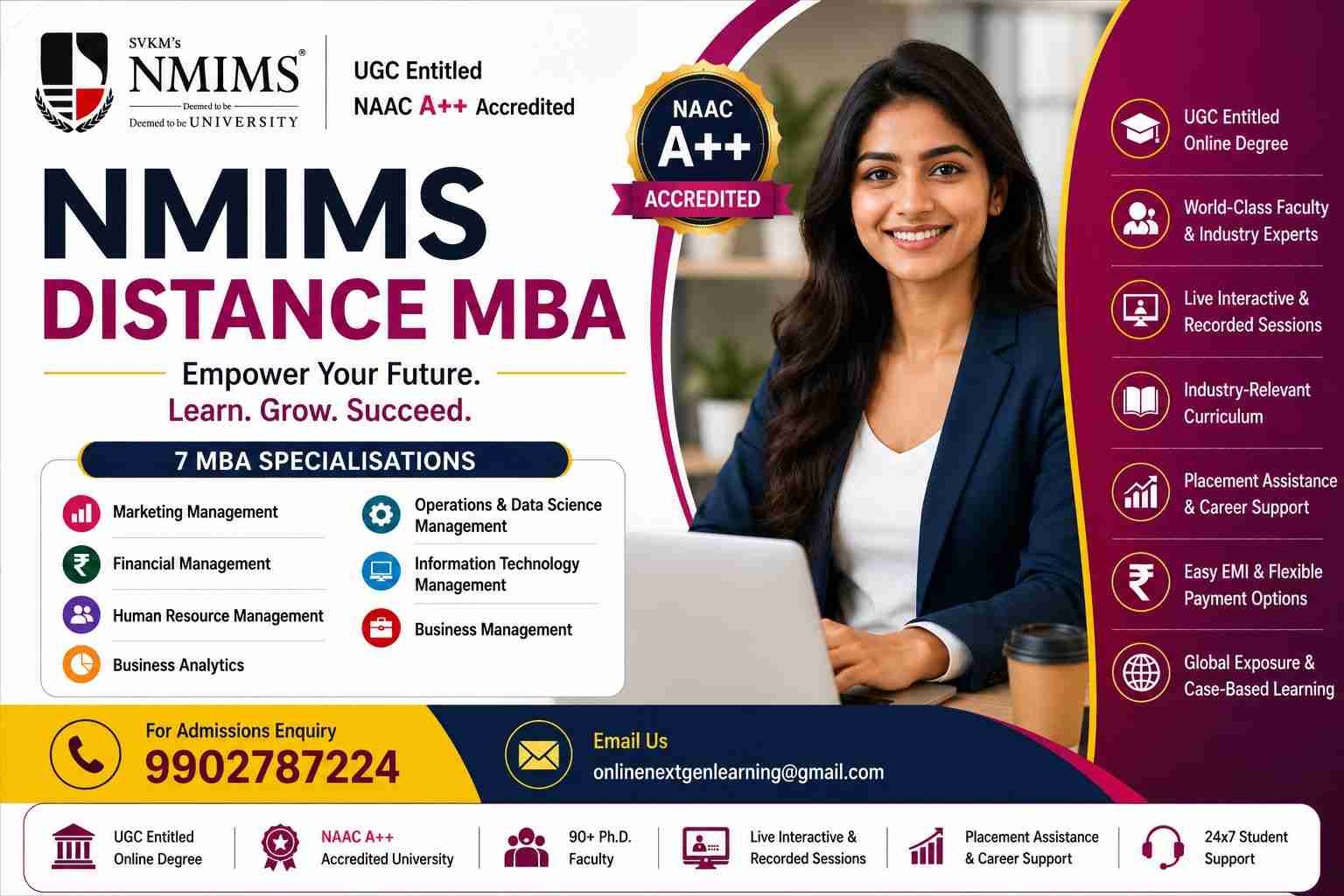
Distance MBA from NMIMS Aligarh
Career progression often creates a practical question: how can someone gain a postgraduate qualification without stepping away from employment? For learners in Aligarh, the answer may lie in a flexible management programme. With education, hardware manufacturing, retail and small enterprises forming part of the local economy, an MBA can be connected to real business situations while being studied through a more adaptable learning model.
Rather than viewing higher education as a pause from professional life, a learner can treat it as a parallel development track. In Aligarh, where education, hardware manufacturing, retail and small enterprises supports different kinds of employment and enterprise, management education can be studied alongside existing activity.
Why Business Fundamentals Matter
An Online MBA can be described as a digitally delivered postgraduate management programme, while a Distance MBA is associated with the broader open and distance learning model. UGC’s framework treats these as separate modes with their own definitions. Prospective learners should therefore check the specific programme’s status rather than assuming that all online and distance courses operate under identical rules.
For someone in Aligarh, the distinction is useful when comparing programmes. Online learning places the internet at the centre of delivery, while distance education can use a wider range of learning media and support services. The important decision is therefore not merely whether a course is called ‘online’ or ‘distance’, but whether the exact programme is appropriately recognised or entitled for the relevant admission cycle.
Online and Distance MBA Explained
An MBA can broaden a student’s understanding of how businesses earn revenue, control costs, manage people, respond to customers and use information. This breadth can complement undergraduate education from commerce, engineering, science, humanities or other disciplines.
A recent graduate can use the MBA to move from subject-specific knowledge towards business understanding. Instead of studying finance, marketing or human resources as isolated topics, the learner sees how they influence organisational performance. This can be useful when preparing for management-oriented interviews or when entering a workplace where different departments must work together.
How Students Build Business Literacy
Professionals with several years of experience can use the programme to formalise knowledge that has previously been learned informally. The MBA supplies frameworks, terminology and structured analysis that can complement practical judgement.
Working professionals can apply classroom concepts immediately. An operations employee can connect process theory with actual workflows; a sales professional can examine customer strategy; an HR executive can relate organisational behaviour to team management. This creates a direct bridge between study and work.
Working Employees and Cross-Functional Skills
Business professionals can use management study to step back from day-to-day activity and examine the organisation as a whole. Finance, customers, employees, processes and growth are connected, and an MBA can provide frameworks for analysing those connections.
A business owner does not need to leave the business environment to study management. In fact, remaining active can make the learning more practical because concepts can be tested against real decisions. The programme can therefore function as both academic study and a structured opportunity for reflection.
Entrepreneurs and Commercial Decision-Making
- Reduced relocation requirement
- Career-compatible study
- Wider managerial perspective
- Technology-enabled learning
- Regular academic milestones
- Business-oriented curriculum
- Potential to strengthen professional confidence
For learners in Aligarh, these benefits are most meaningful when they match an actual career requirement. Flexibility can solve the scheduling problem, while the curriculum provides the academic substance. Neither replaces the learner’s responsibility to study consistently and participate in assessments.
Curriculum and Specialisations
The Distance MBA from NMIMS is organised as a two-year, four-semester postgraduate management programme. The common foundation covers major business areas before students move towards advanced subjects and their selected specialisation. For professionals connected with education, hardware manufacturing, retail and small enterprises, this breadth can be useful because business decisions rarely belong to one function alone.
A learner first develops a shared understanding of how organisations work and then studies more focused areas. This progression is important because managers need both functional knowledge and the ability to see relationships across departments.
MBA Specialisations
- Marketing Management
This specialisation can suit learners interested in markets, customers, brands and sales.
- Financial Management
This specialisation can suit learners interested in financial planning, investment and corporate finance.
- Human Resource Management
This specialisation can suit learners interested in people, recruitment, development and organisational processes.
- Operations & Data Science Management
This specialisation can suit learners interested in processes, analytics and data-supported operational decisions.
- Business Management
This specialisation can suit learners interested in integrated managerial understanding.
- Business Analytics
This specialisation can suit learners interested in data-led business analysis and decision-making.
- Information Technology
This specialisation can suit learners interested in technology-enabled management and digital business.

Eligibility, Fees and Admission
Candidates from commerce, science, engineering, humanities and other disciplines can consider the MBA when they meet the prescribed academic requirement. The published criterion specifies graduation and the stated marks threshold, with the applicable category concession.
Payment Option | Fee | Details |
Annual Fee | ₹1,05,000 | Annual payment |
Semester-wise Fee | ₹55,000 | Per semester |
One-time Fee | ₹1,96,000 | Full programme |
Admission Processing Fee | ₹1,200 | Applicable charge |
Exam Fee | ₹800 | Per subject / attempt |
Project Fee | ₹800 | Per attempt |
The payment options allow a learner to choose between spreading the principal programme fee and using the one-time route. Other academic charges should be considered separately.
The online admission process generally involves programme selection, registration, completion of the application, document submission, payment and enrolment. Learners should make sure that personal and academic information matches the supporting records. UGC-DEB requirements such as DEB-ID may also apply to learners enrolling in recognised ODL or online programmes.
Accreditation and Recognition
- NAAC Rating: A++ Grade (CGPA 3.67 / 4.0).
- UGC Status: Recognised and entitled under the applicable UGC and Distance Education Bureau (DEB) framework.
- University Status: Category-I Deemed-to-be-a-University under the UGC graded autonomy framework.
Recognition should be evaluated for the exact programme and admission session. Institutional reputation and regulatory recognition are related but should not be treated as substitutes for checking the applicable programme status.
Key Points
- UGC-DEB recognised – Fully recognised online degrees
- NAAC A++ Accredited – CGPA of 3.67 / 4.0 – Excellent rating
- Recognised – In India and abroad
- Accepted – For Employment, Higher Studies & Promotions
- Same Academic Validity – As Regular Degrees
- 100% Financing Available – With 0% EMI Options
- Eligible – For Central & State Government Jobs
- No Age Limit – Learn at any stage of your career
- No Career Break Required – Study while working full-time
- Recorded Lectures – Learn at your own pace
- Live Interactive Sessions – Direct faculty access
- Continuous Internal Assessments – Reduced exam pressure
- Dedicated Student Support – Academic & technical assistance
- Online Exams with Flexible Slots – Convenience assured
Final Assessment
Online learning does not remove academic discipline. Students still have to read, prepare assignments, participate in relevant activities and complete examinations. The benefit is that the learner has greater control over where and when much of the study activity is organised.
Career progression after an MBA depends on more than the qualification. Communication, analytical ability, leadership behaviour, digital skills, work experience and role-specific competence all influence outcomes. The programme can provide a formal management foundation on which these capabilities can be developed.
Conclusion
Different learners will use the programme differently. A graduate may seek a foundation for a management career, an employee may prepare for broader responsibilities and a business professional may want stronger strategic thinking. For all three, the programme provides a structured academic route that can be pursued with greater flexibility.
For programme-related assistance and admission guidance, contact: