
DISTANCE MBA IN HRM
DISTANCE MBA IN HRM has become a compelling management education option for graduates, professionals, and aspiring HR leaders who want to develop specialized Human Resource Management expertise while continuing their professional journey. As organizations increasingly recognize that people, culture, leadership, and talent directly influence business performance, the role of HR has moved far beyond traditional recruitment and administration.
A Distance MBA in Human Resource Management brings together fundamental business education and specialized HR knowledge. It introduces learners to areas such as Human Resource Management, organizational behavior, talent acquisition, compensation and benefits, employee relations, performance management, learning and development, manpower planning, and organizational development.
The program is particularly relevant for professionals who want flexibility in higher education. Instead of stepping away from employment, learners can pursue management education through a flexible learning model while continuing their careers.
Why Is a Distance MBA in HRM Becoming a Popular Career Choice?
The modern HR department has evolved into a strategic business function. Organizations need professionals who can attract the right talent, develop employees, improve performance, manage workplace relationships, support organizational change, and align workforce strategies with business objectives.
A Distance MBA in HRM can provide a structured academic foundation for understanding these responsibilities. It combines HR specialization with subjects covering finance, economics, marketing, strategy, analytics, operations, and international business.
This combination can help learners develop a broader understanding of how HR decisions influence an organization’s overall performance.
What Is a Distance MBA in HRM?
A Distance MBA in HRM is a postgraduate management program specializing in Human Resource Management. It combines general management education with focused study of HR functions and organizational practices.
The provided source describes the program as suitable for graduates and working professionals and emphasizes flexibility, academic learning, industry relevance, and professional development.
Students can develop knowledge in areas such as:
- Talent acquisition
- Human Resource Management
- Performance management
- Employee engagement
- Compensation and benefits
- Industrial relations
- Recruitment and selection
- Manpower planning
- Organizational development
- Learning and development
- Emotional intelligence
- Strategic management
- Business analytics
Why Choose a Distance MBA in HRM?
- Continue Your Career While Studying
One of the strongest advantages of a distance-learning model is flexibility. Working professionals can continue their employment while pursuing higher education.
The source specifically highlights the ability of professionals to continue working while pursuing the program from home.
This can be particularly useful for employees who cannot afford to take a career break.
- Develop Specialized HR Expertise
HR is a broad discipline. Professionals may work in recruitment, compensation, employee relations, learning and development, performance management, or organizational development.
A specialized MBA can help learners understand these different HR functions within a broader management framework.
- Strengthen Business and Management Knowledge
HR professionals frequently work with finance, operations, marketing, senior management, and business leadership.
Therefore, understanding subjects such as accounting, economics, marketing, strategic management, business analytics, corporate finance, and operations can strengthen a professional’s overall management perspective.
- Prepare for Leadership Responsibilities
As professionals progress in their careers, HR responsibilities often become more strategic.
An MBA-level education can provide conceptual knowledge relevant to workforce planning, organizational development, performance management, employee development, and strategic decision-making.
Distance MBA in HRM Fee Structure
According to the provided source, the fee structure includes the following options:
|
Fee Option |
Amount |
|
Annual Fee |
₹1,05,000 |
|
Semester-wise Fee |
₹55,000 per semester |
|
One-time Program Fee (Optional) |
₹1,96,000 |
These fee figures are taken directly from the supplied source material. Students should verify the latest applicable fee structure, payment terms, and admission-cycle information before enrollment.
Eligibility for Distance MBA in HRM
The provided material states that candidates should have:
- A Bachelor’s Degree (10+2+3) from a recognized university.
- Minimum qualifying marks as prescribed by the university.
Applicants should confirm the latest eligibility requirements with the institution before applying because admission criteria can vary according to current university policies.
Distance MBA in HRM Curriculum
A strong HR professional needs an understanding of both people management and business management. The curriculum provided in the source reflects this combination.
Semester 1
The first semester includes:
- Business Communication
- Financial Accounting
- Micro Economics & Macro Economics
- Organisational Behavior
- Marketing Management
- Quantitative Methods – I
These subjects establish the fundamentals of business communication, accounting, economics, organizational behavior, marketing, and quantitative analysis.
Semester 2
The second semester includes:
- Cost & Management Accounting
- Human Resource Management
- Strategic Management
- Business Analytics
- Legal Aspect of Business
- Operations Management
This stage introduces specialized HR learning while developing knowledge of business strategy, analytics, accounting, law, and operations.
Semester 3
The third semester includes:
- Corporate Finance
- Research Methodology
- Project Pre-work
- Compensation & Benefits
- Industrial Relations & Labour Laws
- Manpower Planning, Recruitment and Selection
- Organisational Development & Change
This semester moves deeper into HR specialization. Students explore compensation, labour laws, recruitment, workforce planning, and organizational development.
Semester 4
The final semester includes:
- Indian Ethos & Ethics
- Corporate Sustainability
- International Business
- Project
- Performance Management System
- Learning & Development
- Emotional Intelligence
The final stage combines management concepts with advanced HR-related areas such as performance, employee development, and emotional intelligence.
The complete four-semester structure and subjects are provided in the source material.
Key Skills Developed Through a Distance MBA in HRM
An effective HR professional needs a combination of technical knowledge, business understanding, communication ability, analytical thinking, and people-management skills.
Talent Acquisition and Recruitment
Recruitment is one of the core functions of HR. Knowledge of manpower planning, recruitment, and selection can help professionals understand how organizations identify and acquire talent.
Compensation and Benefits
Compensation influences employee attraction, retention, motivation, and organizational cost management. The program includes dedicated learning in Compensation & Benefits.
Performance Management
Organizations need structured systems for setting expectations, evaluating performance, and supporting employee improvement. Performance Management System is included in the fourth semester.
Learning and Development
Organizations need continuous employee development to build capabilities and prepare future leaders. Learning & Development is therefore an important component of the curriculum.
Industrial Relations and Labour Laws
HR professionals must understand workplace relationships and the legal framework governing employment. Industrial Relations & Labour Laws provides focused exposure to this area.
Organizational Development
Organizations continually change because of technology, competition, restructuring, growth, and changing workforce expectations. Organizational Development & Change helps learners understand this dimension of HR.
Emotional Intelligence
HR involves continuous interaction with employees, managers, teams, and leadership. Emotional intelligence can contribute to better interpersonal communication and workplace relationship management.
Why Is a Distance MBA in HRM Suitable for Working Professionals?
For a working professional, leaving employment to pursue a full-time MBA may not always be practical.
A distance learning model offers greater flexibility and allows professionals to continue their careers while studying. The source specifically identifies working professionals as a key audience and emphasizes flexible learning.
This makes the program particularly relevant to:
- HR executives
- Recruitment professionals
- Talent acquisition specialists
- HR generalists
- Payroll and employee-relations professionals
- Training professionals
- Working managers
- Graduates entering HR
- Professionals transitioning into HR
Distance MBA in HRM Career Opportunities
Human Resource Management provides career opportunities across multiple organizational functions.
According to the supplied material, graduates can explore roles such as:
- HR Executive
- HR Generalist
- Talent Acquisition Specialist
- Recruitment Manager
- HR Business Partner
- Training and Development Manager
- Compensation and Benefits Manager
- Employee Relations Manager
- Performance Management Specialist
- Organizational Development Consultant
- HR Analyst
- Human Resource Manager
- Senior HR Manager
- Vice President – Human Resources
Career progression will depend on professional experience, individual skills, employer requirements, performance, specialization, and leadership capabilities.
Industries Offering HR Career Opportunities
HR professionals are required in organizations of almost every size and sector.
The source identifies several industries where HR professionals can build careers:
- Information Technology
- Banking and Financial Services
- Manufacturing
- Healthcare
- Retail
- Education
- Consulting
- Telecommunications
- Hospitality
- E-commerce
- Startups
- Government organizations
This cross-industry demand gives HR professionals the flexibility to explore different sectors during their careers.
Why Consider NMIMS CDOE for Distance MBA in HRM?
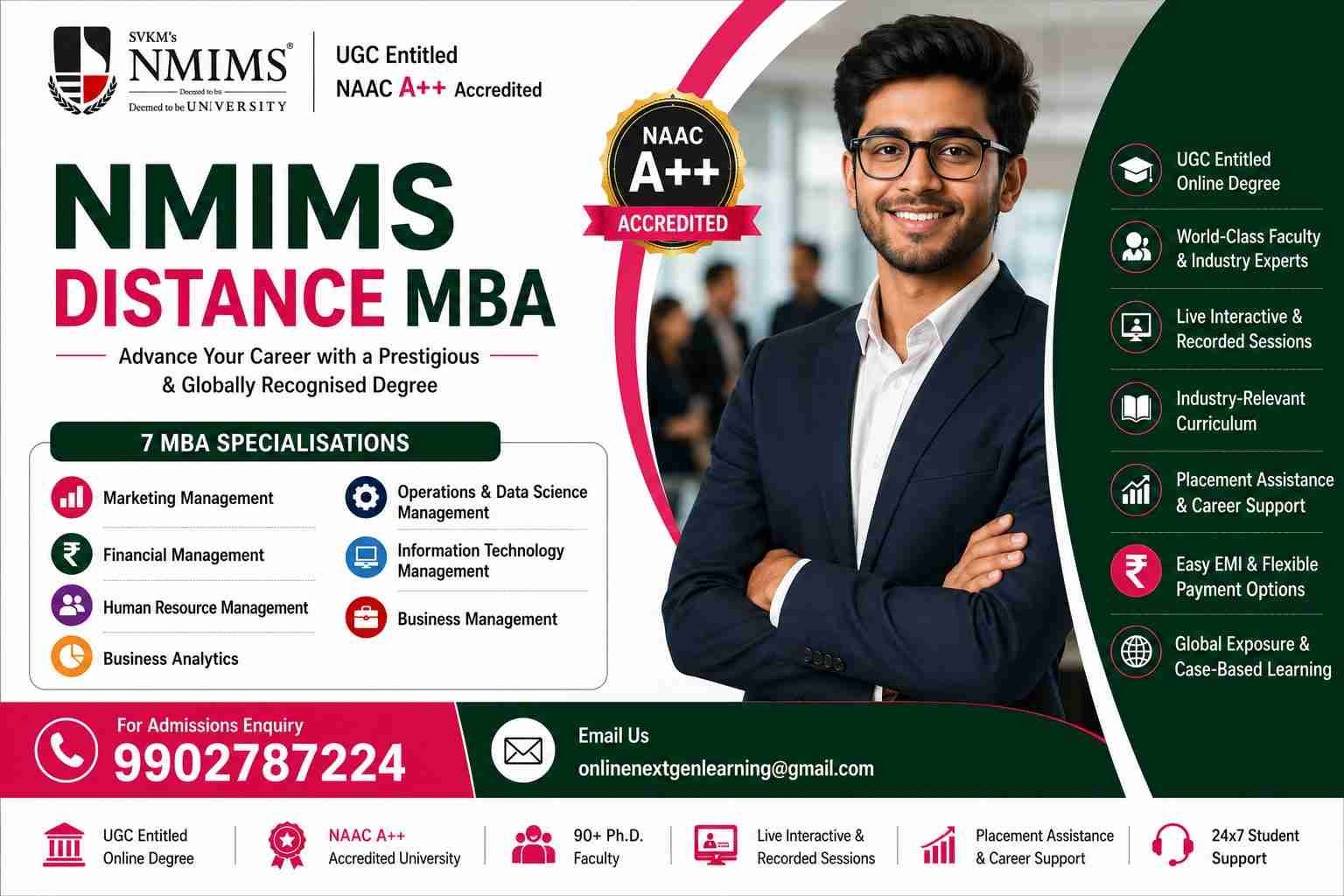
The supplied material presents NMIMS Centre for Distance and Online Education (CDOE) as an established provider of online and distance education. It highlights more than 40 years of academic excellence and more than two decades of online and distance education experience.
The source also highlights:
- NAAC A++ accredited university
- UGC-entitled online degree programs
- More than 40 years of academic excellence
- Over two decades of online education expertise
- Industry-focused curriculum
- Flexible learning for working professionals
- Live faculty interaction
- Recorded lectures
- Advanced digital learning ecosystem
- Experienced faculty
- Dedicated student support
- Nationally recognized university brand
- Strong alumni network
- Case studies and projects
- Career-oriented specializations
- Academic validity comparable to other recognized university degrees
These factors can be considered when comparing a management program with other available options.
Distance MBA in HRM vs Other Management Programs
Choosing the right specialization depends largely on career goals.
A general MBA can provide broad management exposure, while an MBA specializing in HRM provides focused knowledge of people management, recruitment, employee development, compensation, organizational development, and related areas.
Students who already know that they want to build a career in HR may find a specialized HRM program more directly aligned with their professional objectives.
Professionals who want broader exposure across several business functions may instead consider a general management specialization.
The right choice ultimately depends on the learner’s existing experience, career plans, professional interests, and desired job role.
Digital Learning Experience
Distance and online management education increasingly relies on digital learning environments.
The provided source describes features including an advanced Learning Management System, live interactive classes, recorded lectures, e-books, digital library resources, quizzes, assignments, discussion forums, and student support.
These resources can allow learners to access academic material more flexibly and revisit learning content according to their schedules.
However, the effectiveness of distance education also depends on the student’s discipline. Regular participation, timely completion of assignments, examination preparation, interaction with faculty, and consistent self-learning remain important.
Who Should Pursue a Distance MBA in HRM?
Working HR Professionals
Professionals already working in HR can use the program to strengthen their academic and management foundation.
Recruitment and Talent Acquisition Professionals
Recruiters can expand their knowledge beyond hiring by studying workforce planning, organizational behavior, strategy, and employee development.
Fresh Graduates
Graduates interested in establishing an HR career can gain exposure to both management fundamentals and specialized HR subjects.
Professionals Changing Careers
Employees from other functions who want to transition into HR can use an HR-focused MBA as part of their academic development.
Professionals Seeking Career Advancement
Employees aiming for managerial or strategic HR responsibilities may consider higher management education as part of their professional growth.
How to Choose the Right Distance MBA in HRM
Selecting a program should involve more than comparing advertisements or fee structures.
Before enrolling, evaluate:
University Recognition
Check the institution’s current recognition, accreditation, and applicable regulatory status.
Curriculum
Review the complete syllabus and determine whether it matches your intended HR career path.
Faculty and Academic Interaction
Understand how live sessions, faculty interaction, doubt resolution, and academic guidance are provided.
Learning Platform
Evaluate the LMS, recorded content, digital library, e-books, quizzes, assignments, and other resources.
Examination and Assessment
Understand the examination structure, assignment requirements, project work, and evaluation process.
Student Support
Check how academic and administrative assistance is provided throughout the program.
Fees
Compare the total program cost, payment options, and other applicable charges.
Flexibility
Ensure that the academic schedule can be managed alongside employment and other responsibilities.
Career Alignment
Most importantly, identify the specific HR role you want to pursue and determine whether the curriculum supports that objective.
Is a Distance MBA in HRM Worth It?
A Distance MBA in HRM can be worth considering for professionals who want specialized HR knowledge combined with broader business education.
Its usefulness depends on how effectively students apply their learning. An MBA can provide an academic foundation, but career growth also depends on practical experience, communication, analytical ability, leadership, professional networking, technology awareness, and continuous skill development.
For an HR professional, the combination of education and practical workplace exposure can be particularly valuable.
The Future of Human Resource Management
The HR profession is changing rapidly. Organizations increasingly need HR teams that understand people, business strategy, technology, organizational culture, workforce planning, performance, and employee development.
This means future HR professionals need more than traditional administrative knowledge.
They need to understand how people strategies contribute to organizational objectives.
A Distance MBA in HRM can provide a structured academic route for developing this broader management perspective while allowing professionals to maintain continuity in their careers.
Final Conclusion
DISTANCE MBA IN HRM can be a strategic academic choice for graduates and working professionals who want to develop expertise in Human Resource Management without putting their careers on hold.
The program outlined in the supplied material combines core management education with specialized HR subjects covering Human Resource Management, Compensation & Benefits, Industrial Relations & Labour Laws, Manpower Planning, Recruitment and Selection, Organizational Development & Change, Performance Management, Learning & Development, and Emotional Intelligence.
Its flexible learning model makes it particularly relevant for working professionals, while the broader management curriculum can help learners understand HR within the larger context of business.
NMIMS CDOE is highlighted in the source for its academic legacy, distance and online education experience, digital learning ecosystem, faculty interaction, student support, industry-oriented curriculum, and professional focus.
Whether your objective is to enter HR, strengthen your existing HR career, transition from another business function, or prepare for greater managerial responsibility, a Distance MBA in HRM can provide a structured foundation for long-term professional development.
The key is to choose the program carefully, verify the latest institutional information, understand the curriculum and eligibility requirements, and select a specialization that genuinely matches your career ambitions.
For admissions and details regarding Online MBA, Online BBA, Online B.Com, or Online WXMBA programs:
Website: https://onlinenextgenlearning.com
Email: onlinenextgenlearning@gmail.com
Mobile: +91 9902787224