
Affordable Online MBA in Sangli
Looking for an Affordable Online MBA? The best programme is one that matches your budget, schedule, academic expectations, and career goals.
An Affordable Online MBA can be particularly useful for employees who cannot leave their jobs for full-time study.
Entrepreneurs may also find an Affordable Online MBA valuable because learning can continue alongside business operations. An Affordable Online MBA from NMIMS CDOE offers a combination of flexible delivery, institutional credibility, digital learning, and a professional ecosystem.
A Practical Financial Choice for Career-Focused Learners
The first point to consider is affordability in the context of the learner’s entire life. NMIMS CDOE offers annual and semester-wise fee payment choices, giving students different ways to plan their education expenditure.
Online study may also reduce costs connected with travel, accommodation, relocation, and time away from employment. For a working professional, continuing to earn while studying can make the overall investment more manageable.
For students, affordability can influence whether postgraduate study is possible immediately after graduation. For employees, it can determine whether education can be pursued without affecting family or financial responsibilities. For business professionals, it can make formal management education easier to integrate into an already demanding schedule. The value of NMIMS CDOE therefore lies not only in the tuition structure but also in the flexibility of the learning model.
Program | Duration | Annual Fee | Semester-wise | One-time |
MBA | 2 Years (4 SEM) | ₹105,000 | ₹55,000 | ₹196,000 |
B.COM | 3 Years (6 SEM) | ₹33,000 | ₹18,000 | ₹94,000 |
BBA | 3 Years (6 SEM) | ₹47,000 | ₹25,000 | ₹131,000 |
When the Distance Education Journey Began
The institutional history behind NMIMS CDOE provides important context. NMIMS was founded in 1981, and its distance education programme began in 1994 to meet the needs of learners who wanted to balance professional work with higher education. The current CDOE identity was adopted in 2023. In 2013, the institution received a CSR Awards for Excellence distinction as a leading distance-learning institute. This chronology is more accurate than describing the present CDOE division as having first started in 2013.
The Seven Specialisation Options
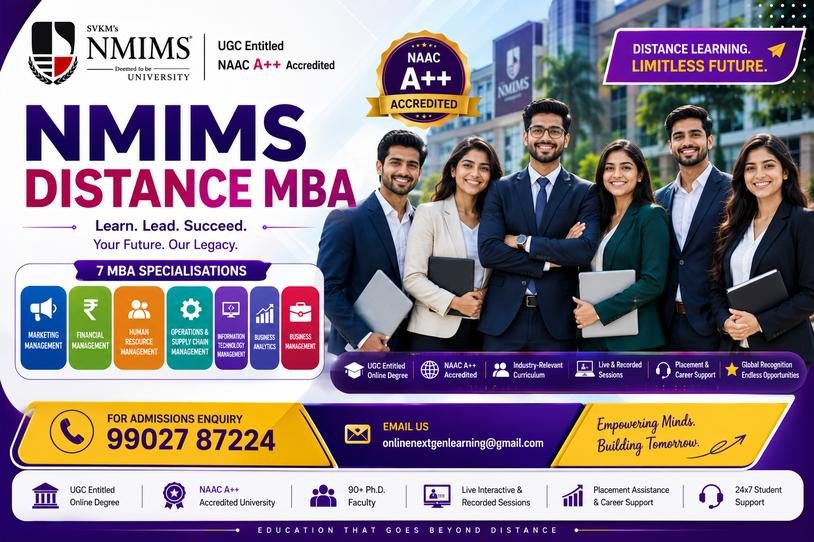
The Online MBA provides seven specialisation choices. Students can review the options individually before deciding which academic direction best fits their career plans.
- Marketing Management
- Financial Management
- Human Resource Management
- Operations & Data Science Management
- Business Management
- Business Analytics
- Information Technology
Accreditation and Recognition for Better Decision-Making
Students should verify academic quality and regulatory recognition before paying any programme fee. NMIMS has NAAC A++ accreditation with a CGPA of 3.67 out of 4.0. The Online MBA operates within the UGC-DEB framework applicable to recognised or entitled online programmes. Because recognition can be programme- and session-specific, applicants should confirm the current status through the official regulatory portal before admission.
- UGC-DEB recognised – Fully recognised online degrees
- NAAC A++ Accredited – CGPA of 3.67 / 4.0 – Excellent rating
- Recognised – In India & Abroad
- Accepted – For Employment, Higher Studies & Promotions
- Same Academic Validity – As Regular Degrees
- 100% Financing Available – With 0% EMI Options, subject to lender terms
- Eligible – For Central & State Government Jobs
- No Age Limit – Learn at any stage of your career
- No Career Break Required – Study while working full-time
- Recorded Lectures – Learn at your own pace
- Live Interactive Sessions – Direct faculty access
- Continuous Internal Assessments – Reduced exam pressure
- Dedicated Student Support – Academic & technical assistance
- Online Exams with Flexible Slots – Convenience assured
Why It Works for Students, Employees and Business Professionals
The student experience can be more flexible than a conventional campus schedule. Learners can organise study around employment, internships, family commitments, or other responsibilities. This makes the the management programme useful for people who want to accumulate professional experience while studying rather than postponing employment until after graduation.
Employees can benefit from applying management concepts directly to their workplace. Learning about leadership, finance, operations, marketing, analytics, or strategy can influence how professionals approach current projects. Over time, this can help them demonstrate greater readiness for responsibilities that require coordination, analysis, and decision-making.
Business professionals can use formal management education to bring greater structure to entrepreneurial decisions. Academic frameworks can complement practical experience by encouraging systematic analysis of customers, competitors, financial performance, people, processes, and growth opportunities. This can be especially useful for business owners who have learned through experience but want a broader management perspective.
Alumni Network and Career Development
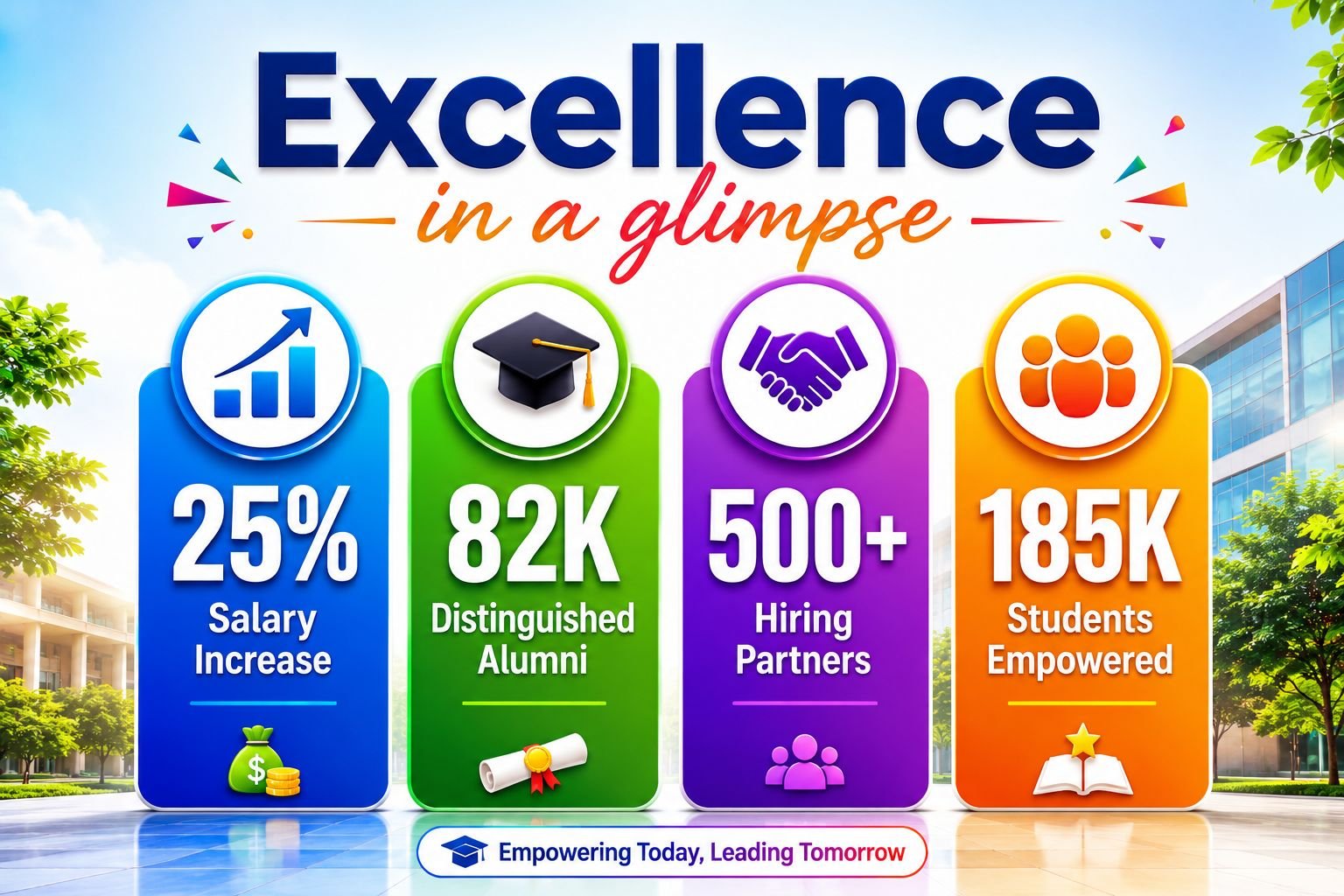
The career ecosystem surrounding a programme can influence how learners continue building professional connections after graduation. NMIMS CDOE highlights 82K+ Distinguished Alumni, 500+ Hiring Partners, and a reported 25% Salary Increased. These figures are best understood as broad institutional indicators rather than individual guarantees. A learner’s actual salary growth or hiring outcome depends on professional experience, skills, performance, role, industry, geography, and market conditions.
The alumni network can help graduates remain connected to a wider professional community. Networking can support knowledge exchange, industry awareness, career exploration, and professional relationships. Hiring partners can broaden awareness of potential opportunities, while individual preparation remains necessary to compete successfully for roles.
After completing the qualification, graduates can pursue progression in their existing field or explore adjacent management functions. A professional with strong experience may target supervisory or managerial roles. A graduate with limited experience can combine the qualification with internships, projects, and practical certifications. Entrepreneurs can use the learning to improve business systems and decision-making. Career growth is strongest when the degree is paired with continuous skill development.
How Online Classes Work
The learning model combines different methods so students do not have to depend on a single teaching format. NMIMS CDOE supports a digital academic environment where learners can engage with faculty, review recorded content, access study material, complete assessments, and receive student support.
- Live interactive sessions create opportunities to communicate with faculty and participate in academic discussions.
- Recorded lectures make revision easier and allow learners to study when professional schedules are more convenient.
- Digital resources provide access to course content and supporting academic materials from suitable devices.
- Continuous internal assessments encourage regular study and provide ongoing academic feedback.
- Online examinations and student support services help learners manage the programme without daily physical attendance.
The digital delivery model can be used across the management programme, Online BBA, and Online B.Com programmes, although the academic content and rules for each course may differ. Applicants should check the latest official programme information before registering.
Making the Qualification More Valuable After Graduation
Completing an the management programme is a milestone, not the end of professional development. Graduates can strengthen the value of their qualification by seeking roles that involve greater responsibility, taking ownership of measurable projects, improving communication, learning new digital tools, and developing leadership behaviours. These actions make academic knowledge visible through workplace performance.
Professionals can also use their qualification when planning a career transition. A move into marketing, finance, human resources, operations, analytics, technology, or general management may require a combination of academic knowledge and practical evidence. The specialisation can support the academic side of that transition, while projects and work experience provide the evidence.
For students, the period after graduation can be used to build a portfolio of practical work, internships, certifications, and achievements. For experienced employees, the focus may be on translating new management knowledge into promotions or expanded responsibilities. For entrepreneurs, it may mean improving processes, strengthening financial discipline, or creating more systematic growth plans.
Admissions and Further Information
For admissions and details regarding the management programme, Online BBA, Online B.Com, or Online WXMBA programmes, visit the [NMIMS Centre for Distance and Online Education](https://onlinenextgenlearning.com). Prospective learners can also use the contact details below for admission assistance.
Email:onlinenextgenlearning@gmail.com
Phone:+91 9902787224